Bhutan "The Land of the Thunder Dragon",
Bhutan is a landlocked country in South Asia, located in the eastern Himalayas. Since the 17th century, its official name has been Druk Yul, or "Land of the Thunder Dragon". Bhutan has a rich and unique cultural heritage, largely preserved due to its isolation from the rest of the world until the mid-20th century. The country is distinguished by a sustainable and original tourism model, a rich Vajrayana Buddhist culture, stunning mountainous landscapes, and a population of around 800,000. Traditional archery is the national and most popular sport in Bhutan; competitions are held between villages, towns, and amateur teams. Buddhism was introduced to Bhutan in the mid-7th century. The country only opened up to tourism in the 1970s, and television was introduced in 1999. It is known for prioritising "Gross National Happiness"
Day 1: Arrival in Paro – Thimphu (Altitude 2400 m)
After your arrival, visa formalities and baggage collection, you will be welcomed by our representative who will be your guide throughout your stay in Bhutan. On the way to Thimphu, you can visit the Tachogang Lhakhang temple. It was founded by Thangtong Gyelpo after he had a vision of Guru Rimpochhe, Amitaba and Avalokiteshvara at the site. After the visit, continue to Thimphu. Check in to your hotel in Thimphu. In the evening, free time to stroll around the city of Thimphu. Overnight in Thimphu |
Day 2 : Visit to Thimphu (Thimphou)
In the morning, you will visit with the local guide the National Memorial, built by the third king of Bhutan, His Majesty Jigme Dorji Wangchuck, also known as the "father of modern Bhutan". Then visit the Tashichho Dzong, a fortified Buddhist monastery located on the northern outskirts of Thimphu, the capital of Bhutan. After lunch, you will proceed to the following places with the guide:
you start with the Kuensel Phodrang, or Buddha Point, which houses the largest seated Buddha statue in the world, standing at 51 metres (167 feet). Located at the top of a hill overlooking the city of Thimphu. The Simtokha Dzong (“ Palace of the Profound Meaning of Secret Mantras ”) is a small dzong. It was built in 1629 by Zhabdrung Ngawang Namgyal, who unified Bhutan. It is the first dzong of its kind built in Bhutan. After lunch, visit the Motithang Takin Reserve. The Motithang Takin Reserve is a small nature reserve dedicated to the takin, the national animal of Bhutan. Originally a mini-zoo, it has been transformed into a reserve for the takin. The evening is free time to stroll around the city.
Day 3: Thimphu -Trongsa
After breakfast, we visit the largest Buddha Dordenma statue and Simtokha Dzong built in 1628, the first of its kind at the time. An important historical monument that today houses one of the main Dzongkha language institutes. We then begin our journey to Trongsa via the Dochu-la Pass (3,088 m) to get a view of the high Himalayan peaks to the north-east. Continue your journey to Trongsa (189 km). You will notice a change in vegetation at this point, with the mountain forest being replaced by high-altitude dwarf bamboos. Stop en route at Chendebji Chorten, arrive in Trongsa in the late afternoon and settle into the lodge for the night. Night in Trongsa | Altitude: 2398m
Day 4: Trongsa - Bhumthang
After breakfast, your guide will take you to visit the Trongsa Dzong. Built in 1644, this building was the seat of power of the Wangchuck dynasty before it took the lead of Bhutan in 1907. According to tradition, the king of Bhutan first holds the position of *Trongsa Penlop* (governor) before being appointed crown prince, then king. Trongsa also houses an impressive museum, the Ta Dzong (watchtower), dedicated to the Wangchuck dynasty; it is an ideal place to discover the history of the kingdom. After lunch, we take the road to Bumthang (68 km), a journey of about 3 hours. Upon our arrival, we visit two of the oldest and most revered temples: Jambey Lhakhang and Kurje Lhakhang. Check-in at your lodge for the night. Night in Bumthang
Day 5: Visit to Bhumthang and Tang Valley
Today, the visit to the Tang valley is considered one of the most beautiful valleys, but also the highest, with an altitude of about 3,100 metres. We will visit the Ogyencholing Dzong, an ancient fortress that was once the home of the lord of Tang. The central tower of the Dzong has been transformed into a museum and houses a magnificent collection of objects. You will also visit Mebar Tsho (the “Burning Lake”).
Day 6: Bhumthang - Punakha
This morning, we retrace our steps and stop in Punakha for two nights. Punakha was the capital of the country from 1637 to 1907, and it is at the Punakha dzong that the first national assembly was held in 1953. We will arrive in the late afternoon and then check in at the hotel.
Day 7: Visit to Punakha
After breakfast, visit the Punakha Dzong, an imposing building erected at the confluence of two rivers that has withstood, over the centuries, floods, earthquakes, and fires. This Dzong is not only the second oldest but also one of the most majestic monuments in the country. It serves as the winter residence of the chief abbot and it is also where the current king, Jigme Khesar Namgyel Wangchuck, married Jetsun Pema Wangchuck, a commoner who became queen. In the afternoon, you have the option to go rafting. Return to the hotel.
Day 8: Punakha - Paro
This morning, before leaving, we visit Chimi Lhakhang, known as the temple of fertility. We set off early towards Thimphu, where we stop for lunch before continuing to Paro. Upon arrival, we make a quick stop at the National Museum as well as at Paro Dzong (Rinpung Dzong), built in 1646 by Shabdrung Ngawang Namgyal. In the evening, we settle into our hotel for the night.
Day 9: Paro - Tiger Nest trek
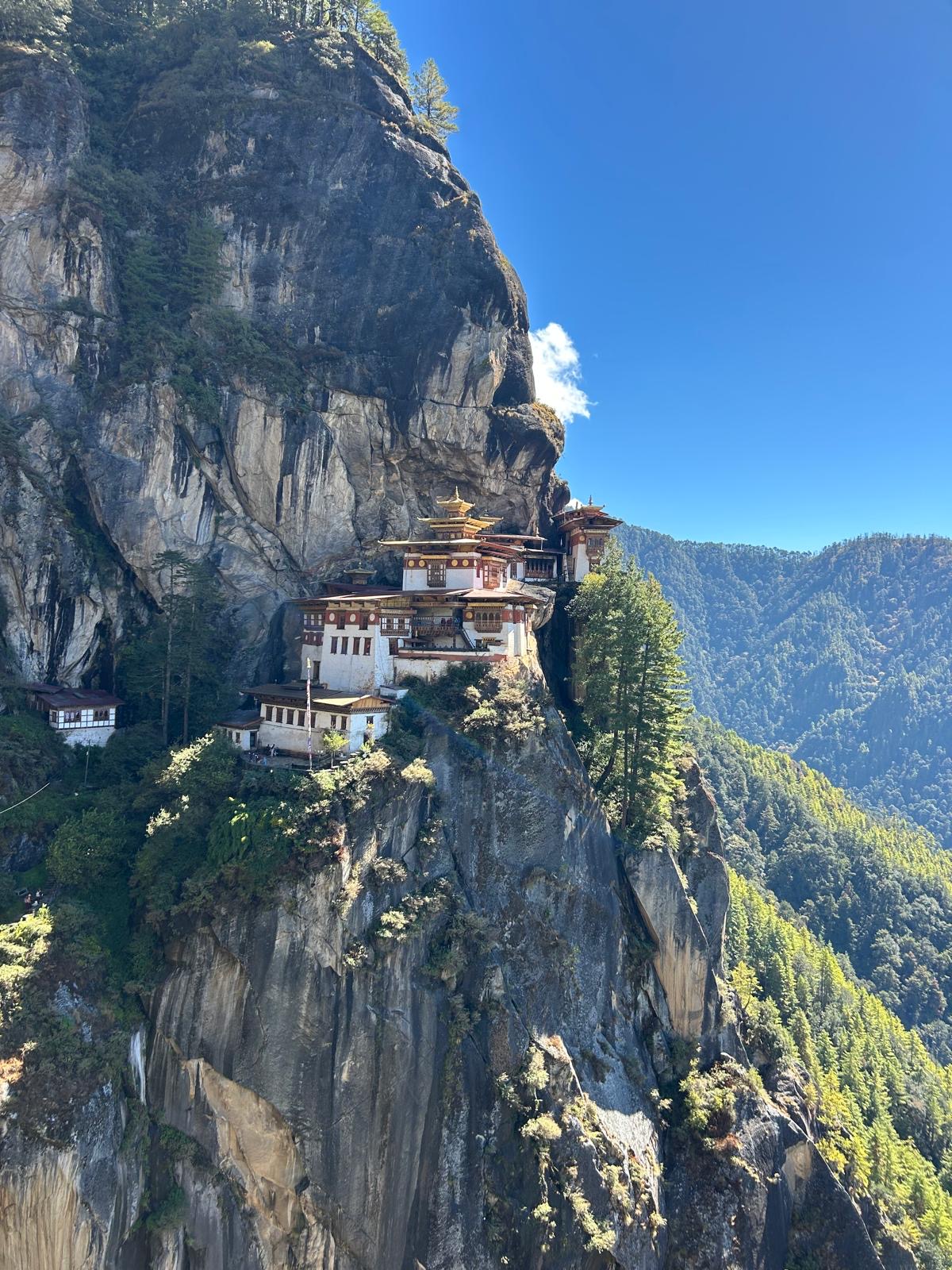
Today, you set off for one of the highlights of our trip. We will start the day early with a climb of about two and a half hours on dirt paths leading to the Taktsang monastery (nicknamed the "Tiger's Nest"). Those who do not wish to make the entire ascent can enjoy a spectacular view of the temple from the café located halfway up. Continue to visit the temple. After the hike, we return to the hotel to freshen up.
A traditional hot stone and herb bath option
Jour 10 Départ.
Today, we will transfer you to the airport for your flight to your next destination.